How much does business automation cost, and how to estimate it before you start
The cost of automation depends less on the tool and more on the task: how many systems it touches, how many exceptions it has, whether it needs AI, and who will maintain it. The best way to estimate is to map one task, work out how long it takes today, and compare that with the build and upkeep over a year.
What drives the cost?
| Factor | Lower cost | Higher cost |
|---|---|---|
| Systems | Two, with a ready connector | Several, some without an API |
| Data | Fixed, clean fields | Free text, files, changing formats |
| Exceptions | Few, with a clear rule | Many cases that need judgment |
| AI | Not needed | Reading text or documents, with human review |
| Stakes | An internal result | Something that reaches a customer or moves money |
What recurring costs should you expect?
- A subscription to an automation tool, or a server that runs the process.
- Usage-based charges for AI services, when they are needed.
- Subscriptions or API access in the systems you connect.
- Upkeep: a change in one system can mean updating the connection.
When you get a quote, ask for recurring costs listed separately from the build.
How do you estimate whether it pays off?
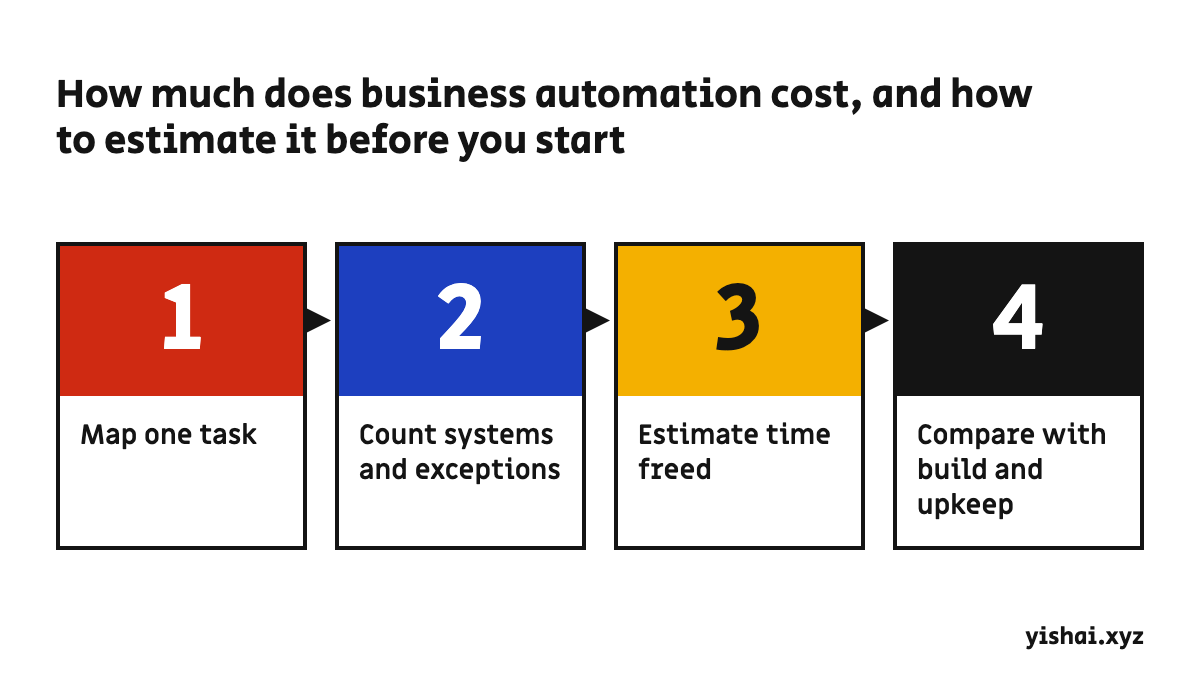
Note how often the task happens each week, how many minutes it takes today, and how many will remain after the change, including review. Multiply by an hourly labour cost to get the monthly value of the time. Compare that with the build and the recurring costs over a year. Our calculator does this arithmetic.
Why start with one task?
One task can be measured before and after, so you see what actually changed. It also surfaces exceptions and data problems early, which are what make large projects expensive. Once it works, extending to similar tasks costs less, because the connections already exist.
What should a quote include?
- Exactly what will be built, and what won't.
- How the result will be tested, and with which examples.
- What happens when something fails, and who is alerted.
- The recurring costs, and who pays them.
- What you get at handover: access, documentation and a walkthrough.
What to prepare before asking for a quote
- Task
- What happens, how often each week, and how long it takes.
- Systems
- Every system the task touches, and whether it has an API.
- Exceptions
- The cases where someone has to decide.
- Measurement
- How you will know the automation works.